
Publications & Media
Books
Malady of Monoculture
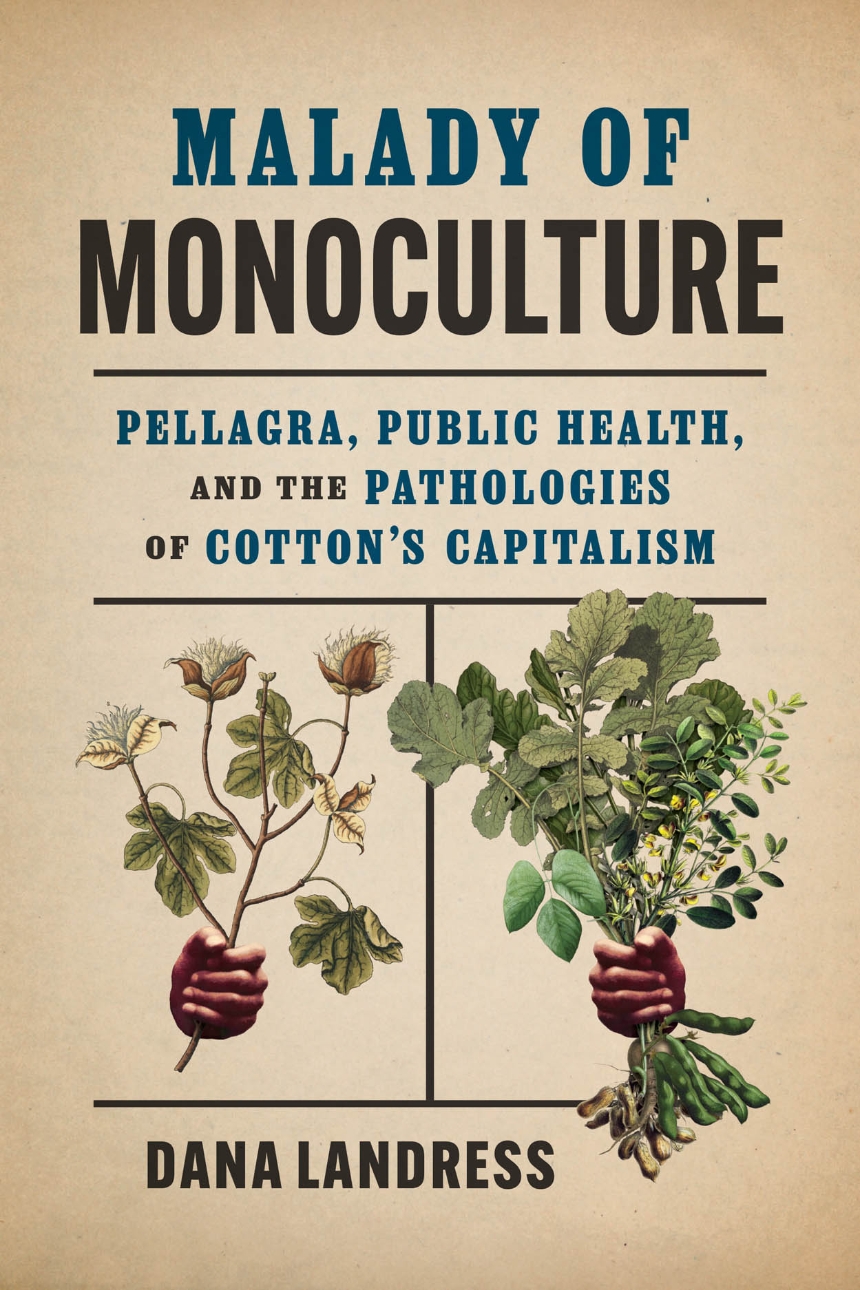
Dana Landress, Malady of Monoculture: Pellagra, Public Health, and the Pathologies of Cotton’s Capitalism, (University of Chicago Press, 2027)

J. Paul Kelleher, The Social Cost of Carbon: Ethics and the Limits of Climate Change Economics, (Oxford University Press, 2025)

Gregg Mitman, Empire of Rubber: Firestone’s Scramble for Land and Power in Liberia, (The New Press, 2021)

Pablo Gomez and Diego Armus (Eds), The Gray Zones of Medicine: Healers and History in Latin America, (University of Pittsburgh Press, 2021)

Lucas Richert and James Hl Mills (Eds), Cannabis: Global Histories, (Cambridge: The MIT Press, 2021)

Lucas Richert, Strange Trips: Science, Culture, and the Regulation of Drugs (McGill-Queen’s University Press, 2019)

Gregg Mitman, Marco Armiero, Robert Emmett (Eds), Future Remains: A Cabinet of Curiosities for the Anthropocene (University of Chicago Press, 2018)

Nicole C. Nelson, Model Behavior: Animal Experiments, Complexity, and the Genetics of Psychiatric Disorders (University of Chicago Press, 2018)
International Society for the History of Behavioral and Social Sciences: Cheiron Book Prize
Finalist
Forum for the History of Science in America: Philip J. Pauly Book Prize
Short Listed

Pablo F. Gómez, The Experiential Caribbean: Creating Knowledge and Healing in the Early Modern Atlantic (University of North Carolina Press, 2017)
Winner of the 2019 William H. Welch Prize for best book in all fields on the History of Medicine
Honorable mention for the 2018 Bolton-Johnson Prize for best book in all fields on Latin American History
Winner of the 2018 Albert J. Raboteau Book Prize for best book in all fields on Africana Religions

Andrew R. Ruis, Eating to Learn, Learning to Eat: The Origins of School Lunch in the United States (Rutgers University Press, 2017)
(Revised from a UW dissertation)

Gregg Mitman, Kelley Wilder (Eds), Documenting the World: Film, Photography, and the Scientific Record (University of Chicago Press, 2016)

Richard C. Keller, Fatal Isolation: The Devastating Paris Heat Wave of 2003 (University of Chicago Press, 2015)

Ronald L. Numbers, Kostas Kampourakis, eds., Newton’s Apple and Other Myths about Science (Harvard University Press, 2015)

Linda F. Hogle (Ed.), Regenerative Medicine Ethics: Governing Research and Knowledge Practices (Springer, 2014)

Terrie Dopp Aamodt, Gary Land, and Ronald L. Numbers, eds., Ellen Harmon White: American Prophet (Oxford University Press, 2014)

Charles L. Cohen and Ronald L. Numbers, eds., Gods in America: Religious Pluralism in the United States (Oxford University Press, 2013)

Warwick Anderson, Deborah Jenson, Richard C. Keller, Unconscious Dominions: Psychoanalysis, Colonial Trauma, and Global Sovereignties (Duke University Press, 2011)

Peter Harrison, Ronald L. Numbers, and Michael H. Shank, Wrestling with Nature: From Omens to Science (University of Chicago Press, 2011)

Richard C.Keller, Robert Dingwall, and Carine Vassy, eds., Enregistrer les morts, identifier les surmortalités Une comparaison Angleterre, États-Unis et France (Presses de l’EHESP, l’Ecole des Hautes Etudes en Santé Publique, 2010)

Claire L. Wendland, A Heart for the Work: Journeys through an African Medical School (University of Chicago Press, 2010)

Judith Walzer Leavitt, Make Room for Daddy: The Journey from Waiting Room to Birthing Room (University of North Carolina Press, 2009)

Ronald L. Numbers (ed.), Galileo Goes to Jail and Other Myths about Science and Religion (Harvard University Press, 2009)
A Choice Outstanding Academic Title of 2009

Susan E. Lederer, Flesh and Blood: Organ Transplantation and Blood Transfusion in 20th Century America (Oxford University Press, 2008)

Gregg Mitman, Breathing Space: How Allergies Shape Our Lives and Landscapes (Yale University Press, 2008)
Awarded the William H. Welch Medal by the American Association for the History of Medicine. Winner of a 2008 Outstanding Achievement Award, Wisconsin Library Association. Finalist for the 2007 ForeWord Magazine Book of the Year Award in the Environment category

Ronald L. Numbers, Prophetess of Health: A Study of Ellen G. White (Wm. B. Eerdmans Publishing Company, 2008)

Ronald L. Numbers, The Creationists: From Scientific Creationism to Intelligent Design (Expanded Edition) (Harvard University Press, 2008)

Richard C. Keller, Colonial Madness: Psychiatry in French North Africa (University of Chicago Press, 2007)

Lorraine Daston and Gregg Mitman (eds.), Thinking with Animals: New Perspectives on Anthropomorphism (Columbia University Press, 2005)

Gregg Mitman, Michelle Murphy, and Christopher Sellers (eds.), Landscapes of Exposure: Knowledge and Illness in Modern Environments (Osiris, Volume 19) (University of Chicago Press, 2004)

Robert Streiffer, Moral Relativism and Reasons for Action (Routledge, 2003)

Lynn K. Nyhart and Thomas Broman (eds.), Science and Civil Society (Osiris, Volume 17) (University of Chicago Press, 2002)

Linda F. Hogle, Recovering the Nation’s Body: Cultural Memory, Medicine, and the Politics of Redemption (Rutgers University Press, 1999)

Judith Walzer Leavitt, Women and Health in America (2nd Edition) (University of Wisconsin Press, 1999)

Gregg Mitman, Reel Nature: America’s Romance With Wildlife on Film (Harvard University Press, 1999)
Winner of the 2000 Watson Davis and Helen Miles Davis Prize for the History of Science Society

Ronald L. Numbers, Darwinism Comes to America (Harvard University Press, 1998)
Winner of the 1999 Templeton Foundation Prize for Outstanding Book in Theology and the Natural Sciences

Judith Walzer Leavitt, Typhoid Mary: Captive to the Public’s Health (Beacon Press, 1997)

Judith Walzer Leavitt and Ronald L. Numbers (eds.), Sickness and Health in America: Readings in the History of Medicine and Public Health (third Edition, Revised) (University of Wisconsin Press, 1997)

Thomas H. Broman, The Transformation of German Academic Medicine, 1750-1820 (University of Chicago Press, 1996)

Judith Walzer Leavitt, The Healthiest City: Milwaukee and the Politics of Health Reform (Wisconsin Edition) (University of Wisconsin Press, 1996)

Susan E. Lederer, Subjected to Science: Human Experimentation in America before the Second World War (Johns Hopkins University Press, 1995)
(Revised from a UW dissertation)

Gregg Mitman, The State of Nature: Ecology, Community, and American Social Thought, 1900-1950 (University of Chicago Press, 1992)
Winner of the 1994 Gustave O. Arlt Award in the Humanities from the Council of Graduate Schools
(Revised from a UW dissertation)

Judith Walzer Leavitt, Brought to Bed: Childbearing in America, 1750-1950 (Oxford University Press, 1986)
Film

Gregg Mitman. The Land Beneath Our Feet. (60 min., 2016). Director/Producer, with Sarita Siegel. Available through Passion River http://thelandbeneathourfeet.com.

Gregg Mitman. In the Shadow of Ebola (23 min, 2015). Director/Producer, with Sarita Siegel. A co-production with Alchemy Films and the Independent Television Service (ITVS) with funding provided by the Corporation for Public Broadcasting. http://www.pbs.org/independentlens/in-the-shadow-of-ebola/
Journals
“The Social Cost of Carbon from Theory to Trump,” in Ravi Kanbur and Henry Shue (eds.) Climate Justice: Integrating Economics and Philosophy (Oxford University Press, 2019).
“Pure Time Preference in Intertemporal Welfare Economics,” Economics & Philosophy 33 (2017): 441–473.
“Beneficence, Justice, and Health Care,” Kennedy Institute of Ethics Journal 24(1) (2014): 27-49.
Media Appearances
Dr. Gretchen Schwarze spoke on the Palliatively Speaking podcast
https://www.palliativelyspeaking.com/episodes/debra-lotstein-jeeps-4ptdd
A Public Affair, WORT Radio, “https://www.wortfm.org/”
Tone Madison, “There will be no “climate haven”
Wisconsin Public Radio, “How delta-8 is shaping the marijuana debate in Wisconsin,”
Vanessa Kjeldsen for WMTV-News, “Delta-8 remains largely unregulated in Wisconsin,”
UW–Madison for Spectrum News’ “In Focus,”
Wisconsin Public Radio, “New medical marijuana proposal,”
Nautilus Magazine, “The long history of psychedelic theft,”
CBS 58 – Milwaukee CBS Interview, “Discovered Documents Reveal More About Milwaukee County Insane Asylum”
PBS’s To the Best of Our Knowledge, “Luminous – can psychedelics be decolonized?”
The Badger-Herald, “Wisconsin Democrats introduce bill to legalize recreational marijuana”
BBC Radio4, The Digital Human (2022) Radio/Podcast Interview. Episode: “Implant”, https://www.bbc.co.uk/programmes/m001dws4
Badger Herald (2022) Student Newspaper Interview. “COVID-19 Ripple Effect”. Available at
https://badgerherald.com/news/2022/02/10/covid-19-ripple-effect-how-resource-shortages-impactindividuals-
with-other-life-threatening-conditions/
Banfield (2022) TV Interview. “Hackable Humans: Will Neural Chips Become the New Normal?”.
Available at https://www.youtube.com/watch?v=x9QI3Vtn4ys
Daily Beast (2022) Newspaper Interview. “Experts Are Ringing Alarm Bells About Elon Musk’s Brain
Implants”, https://www.thedailybeast.com/elon-musks-neuralink-inches-closer-to-human-trials-andexperts-
are-ringing-alarms
Alumni

Shannon Withycombe, Lost: Miscarriage in Nineteenth-Century America (Rutgers University Press, 2018)
(Revised from a UW dissertation)

Anna Zeide, Canned: The Rise and Fall of Consumer Confidence in the American Food Industry (University of California Press, 2018)
2019 James Beard Award Winner
(Reference, History, and Scholarship Category)
(Revised from a UW dissertation)

Andrew R. Ruis, Eating to Learn, Learning to Eat: The Origins of School Lunch in the United States (Rutgers University Press, 2017)
(Revised from a UW dissertation)

Camilo Quintero Toro, Birds of Empire, Birds of Nation. A History of Science, Economy, and Conservation in United States-Colombia Relations (Universidad de los Andes, 2012)
(Revised from a UW dissertation)

Edward J. Larson, An Empire of Ice: Scott, Shackleton, and the Heroic Age of Antarctic Science (Yale University Press, 2011)
Awarded an Honorable Mention in the 2011 National Outdoor Book Awards. Shortlisted for the 2012 Hessell-Tiltman prize.

Erika Lorraine Milam, Looking for a Few Good Males: Female Choice in Evolutionary Biology (The Johns Hopkins University Press, 2010)
(Revised from a UW dissertation)

Sarah K. A. Pfatteicher, Lessons amid the Rubble: An Introduction to Post-Disaster Engineering and Ethics (Johns Hopkins University Press, 2010)
(Revised from a UW dissertation)

Jeffrey M. Jentzen, Death Investigation in America: Coroners, Medical Examiners, and the Pursuit of Medical Certainty (Harvard University Press, 2009)
(Revised from a UW dissertation)

Shawn Francis Peters, When Prayer Fails: Faith Healing, Children, and the Law (Oxford University Press, 2008)
(Revised from a UW dissertation)

Pamela Gossin, Thomas Hardy’s Novel Universe (Ashgate, 2007)
(Revised from a UW dissertation)

Daniel Patrick Thurs, Science Talk: Changing Notions of Science in American Culture (Rutgers University Press, 2007)
(Revised from a UW dissertation)

Judith A. Houck, Hot and Bothered: Women, Medicine, and Menopause in Modern America (Harvard University Press, 2006)
(Revised from a UW dissertation)

Michael F. Robinson, The Coldest Crucible: Arctic Exploration and American Culture (University of Chicago Press, 2006)
(Revised from a UW dissertation)

Fa-ti Fan, British Naturalists in Qing China: Science, Empire, and Cultural Encounter (Harvard University Press, 2004)
(Revised from a UW dissertation)

Edward J. Larson, Evolution: The Remarkable History of a Scientific Theory (Modern Library, 2004)

Jole R. Shackelford, Philosophical Path for Paracelsian Medicine: The Ideas, Intellectual Context, and Influence of Petrus Severinus (1540-1602) (Museum Tusculanum Press, 2004)
(Revised from a UW dissertation)

Louise E. Robbins, Elephant Slaves and Pampered Parrots: Exotic Animals in Eighteenth-Century Paris (Johns Hopkins University Press, 2002)
(Revised from a UW dissertation)

Rennie B. Schoepflin, Christian Science on Trial: Religious Healing in America (Johns Hopkins University Press, 2002)
(Revised from a UW dissertation)

Jorge Cañizares-Esguerra, How to Write the History of the New World: Histories, Epistemologies, and Identities in the Eighteenth-Century Atlantic World (Stanford University Press, 2001)
Winner of the 2001 John E. Fagg Prize in Spanish and Latin American History and the 2001 Atlantic History Prize, both from the American Historical Association.
(Revised from a UW dissertation)

Edward J. Larson, Summer for the Gods: The Scopes Trial and America’s Continuing Debate Over Science and Religion (Basic Books, 1997)
Winner of the 1998 Pulitzer Prize in History

Richard C. Sawyer, To Make a Spotless Orange: Biological Control in California (Iowa State Press, 1996)
(Revised from a UW dissertation)

Charlotte G. Borst, Catching Babies: The Professionalization of Childbirth, 1870-1920 (Harvard University Press, 1995)
(Revised from a UW dissertation)

Edward J. Larson, Sex, Race, and Science: Eugenics in the Deep South (Johns Hopkins University Press, 1995)

Susan E. Lederer, Subjected to Science: Human Experimentation in America before the Second World War (Johns Hopkins University Press, 1995)
(Revised from a UW dissertation)

James M. Lattis, Between Copernicus and Galileo: Christoph Clavius and the Collapse of Ptolemaic Cosmology (University of Chicago Press, 1994)
(Revised from a UW dissertation)

Michael A. Osborne, Nature, the Exotic, and the Science of French Colonialism (Indiana University Press, 1994)
(Revised from a UW dissertation)

Hugh Richard Slotten, Patronage, Practice, and the Culture of American Science: Alexander Dallas Bache and the U. S. Coast Survey (Cambridge University Press, 1994)
(Revised from a UW dissertation)

Patricia Spain Ward, Simon Baruch: Rebel in the Ranks of Medicine, 1840-1921 (University of Alabama Press, 1994)
(Revised from a UW dissertation)

Arleen Marcia Tuchman, Science, Medicine, and the State in Germany: The Case of Baden, 1815-1871 (Oxford University Press, 1993)
(Revised from a UW dissertation)

A. Bowdoin Van Riper, Men among the Mammoths: Victorian Science and the Discovery of Human Prehistory (University of Chicago Press, 1993)
(Revised from a UW dissertation)

Elizabeth B. Keeney, The Botanizers: Amateur Scientists in Nineteenth-Century America (University of North Carolina Press, 1992)
(Revised from a UW dissertation)

Gregg Mitman, The State of Nature: Ecology, Community, and American Social Thought, 1900-1950 (University of Chicago Press, 1992)
Winner of the 1994 Gustave O. Arlt Award in the Humanities from the Council of Graduate Schools
(Revised from a UW dissertation)

Roy Jose DeCarvalho, The Founders of Humanistic Psychology (Praeger Publishers, 1991)
(Revised from a UW dissertation)

John Patrick Swann, Academic Scientists and the Pharmaceutical Industry: Cooperative Research in Twentieth-Century America (Johns Hopkins University Press, 1988)
(Revised from a UW dissertation)

Joella G.Yoder, Unrolling Time: Christiaan Huygens and the Mathematization of Nature (Cambridge University Press, 1988)
(Revised from a UW dissertation)

Rima D. Apple, Mothers and Medicine: A Social History of Infant Feeding, 1890-1950 (University of Wisconsin Press, 1987)
(Revised from a UW dissertation)

Edward J. Larson, Trial and Error: The American Controversy Over Creation and Evolution (Oxford University Press, 1985)
(Revised from a UW dissertation)

John M. Eyler, Victorian Social Medicine: The Ideas and Methods of William Farr (Johns Hopkins University Press, 1979)
(Revised from a UW dissertation)